 South Bend Egress Windows
 Window Well Installation and Replacement in South Bend
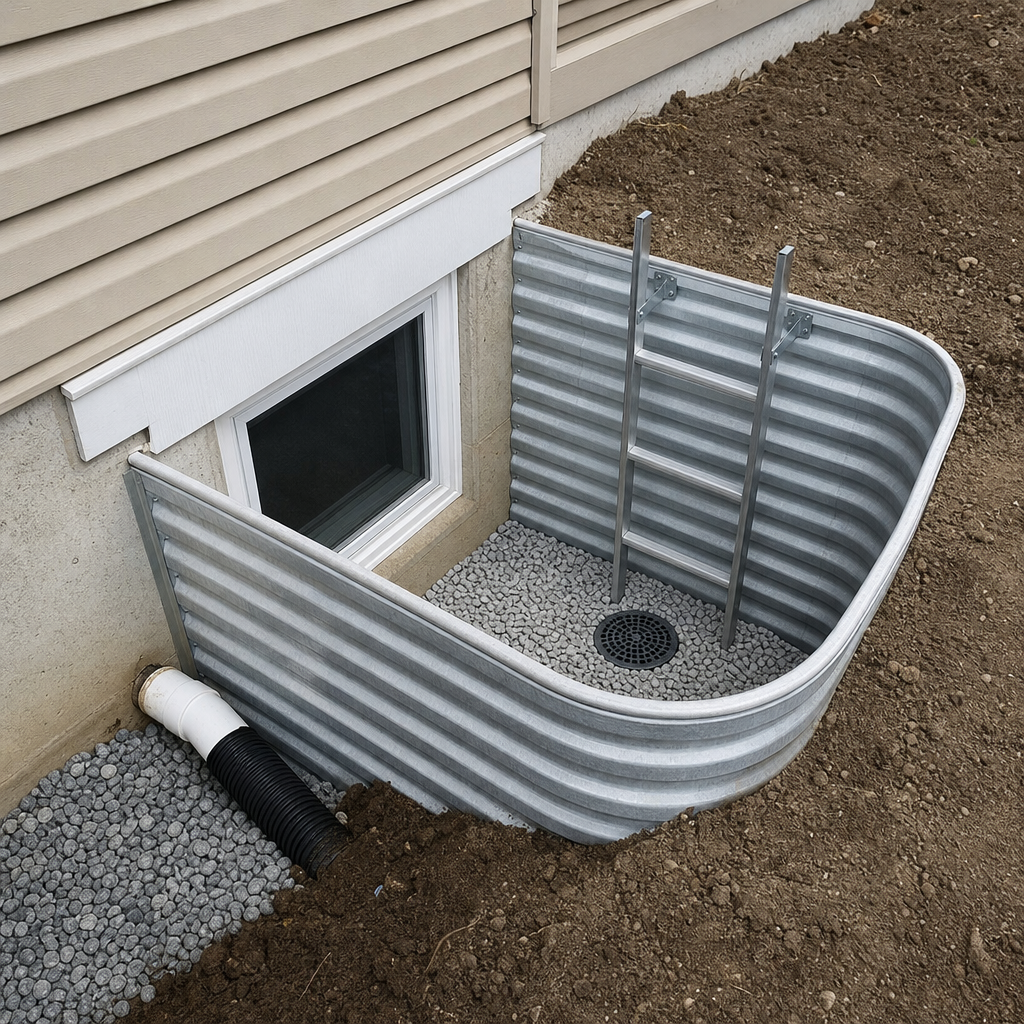
A window well is the pit outside a below-grade egress window that gives you room to climb out, and in South Bend it is also the thing standing between your basement and a season’s worth of lake-effect melt. Code-sized wells go on new egress openings, and rusted, bowed, or flooding wells on existing ones get replaced: $1,000 to $3,000 for a replacement, included in a full egress window installation. Every well gets a gravel drainage bed with a real outlet and a ladder when the code calls for one.
What the Indiana code requires of a well
The 2020 Indiana Residential Code (2018 IRC with Indiana amendments) is specific:
| Requirement | Number | Section |
|---|---|---|
| Horizontal area | at least 9 square feet | R310.2.3 |
| Width and projection from the wall | at least 36 inches each | R310.2.3 |
| Window operation | the well must allow the window to open fully | R310.2.3 |
| Ladder or steps | required when the well is deeper than 44 inches | R310.2.3.1 |
| Rungs | at least 12 inches wide, projecting at least 3 inches, no more than 18 inches on center, full height | R310.2.3.1 |
| Ladder encroachment | may intrude up to 6 inches into the required well dimensions | R310.2.3 exception |
| Drainage | connected to the foundation drainage system or an approved alternative | R310.2.3.2 |
Note what the 9 square feet is for. It is not decoration. It is space for an adult to stand, turn, and climb, or for a firefighter to come down. A 24-inch-deep well that lets the window crack open is a planter, not an escape route, and it fails the final.
Why South Bend wells fail
Rust. Galvanized corrugated wells from the 1960s through the 1980s are at or past end of life across Twyckenham Hills, the east side, and Mishawaka’s post-war streets. Michiana’s freeze-thaw cycling, road salt in the snowmelt, and standing water eat through the galvanizing, and once the steel goes the well bows inward under soil pressure.
No drainage. Most older wells were set on dirt. The Indiana DNR describes the ground under South Bend and Mishawaka as surface sand and gravel over a thick clay layer. Water runs through the sand, hits the clay, and pools, and a well with no gravel bed and no outlet is where it pools. South Bend’s 1991 to 2020 normals are 39.23 inches of precipitation and 64.5 inches of snow a year, with the wettest stretch from mid-winter through early spring according to the National Weather Service, which is exactly when frozen ground cannot absorb any of it.
Wrong size for a bedroom. Plenty of wells were installed for light, not escape: too shallow, too narrow, no ladder. If the room behind the window is now a bedroom, the well is a code problem even if the window is fine.
Pulled away from the wall. A well that was never anchored to the foundation, or was anchored to crumbling block, separates from the wall and lets soil and water in behind it.
How a well is installed
1. Excavate. Dig a working area around the opening, deep enough to reach the footing drain tile if the house has one, and in any case below the 36-inch footing depth Indiana’s code table assigns to St. Joseph County, so the drainage bed works below frost.
2. Set the drainage. A gravel bed under the well, with a perforated drop tied to the footing tile where there is a working loop, to a sump line where there is a sump, or into a deep gravel dry well where the house has neither. Full detail on the covers and drainage page. The code has an exception for foundations on well-drained sand and gravel soils; build drainage anyway, because the sand at the surface around here routinely sits on clay.
3. Anchor the well. Fastened to the foundation with masonry anchors, sealed at the wall, sized to clear 9 square feet and 36 inches of projection with room for the window to open fully.
4. Ladder. If the well is deeper than 44 inches, a permanent ladder built to R310.2.3.1. It belongs on the side, not across the window path.
5. Backfill and grade. Compacted in lifts, graded to slope away from the house, so the well does not become the low point of the yard.
6. Cover. Optional but smart here: a clear polycarbonate cover that sheds snow and leaves, opens from inside without tools, and holds a person’s weight.
Materials and what they cost
Galvanized corrugated steel. The standard. Code-compliant, durable when drained, the low end of the $1,000 to $3,000 range. Available in the deep sizes older South Bend basements need.
Composite (stone or timber look). Rigid, will not rust, looks like a landscape feature instead of a culvert. Costs more, lasts longer, and holds up better to freeze-thaw. Upper half of the range with a ladder and drainage.
Poured or block masonry wells. Occasionally right for a walkout or an oversized opening. Quoted from the measure.
The price moves on depth, access, and whether drainage is being built from scratch or tying into tile that works. The pricing page covers all of it.
Wells on new egress openings
On a full install the well is part of the package. The well should be sized to the window, not the other way around: an in-swing casement needs less well depth for the same opening than a slider set lower, and picking the right combination saves a foot of dig and sometimes the ladder.
Service area
South Bend, Mishawaka, Granger, Osceola, Elkhart, and Goshen. Well replacement in an existing opening usually does not require a structural permit, but a new egress opening always does, and that permit comes from the office covering your address; ask who files it. Dig season runs roughly April through November; if your well flooded this spring, book the measure now so it is fixed before the next one.
Frequently Asked Questions
How big does an egress window well have to be in Indiana?
Section R310.2.3 of the 2020 Indiana Residential Code requires a horizontal area of at least 9 square feet, with width and projection each at least 36 inches, and the well must let the window open fully. A ladder is allowed to encroach up to 6 inches into those dimensions.
When does a well need a ladder?
When it is deeper than 44 inches (R310.2.3.1). The ladder or steps must be permanently affixed and usable with the window fully open, with rungs at least 12 inches wide, projecting at least 3 inches from the wall, spaced no more than 18 inches on center for the full height of the well. Most wells on South Bend's deep older basements qualify.
What does window well replacement cost?
$1,000 to $3,000 for a well in an existing opening, depending on depth, material, and drainage. Galvanized corrugated steel is the low end; composite or stone-look wells with a ladder and a new drainage bed are the high end. Included in a full egress install.
Do you have to dig up my whole yard?
No. We excavate a working area around the existing well, typically a few feet wider than the new well on each side, deep enough to reach the footing tile or set a dry well. Machine access keeps it fast; a hand dig on a tight lot takes longer, and you should hear that up front.