 South Bend Egress Windows
 Basement Window Replacement in South Bend
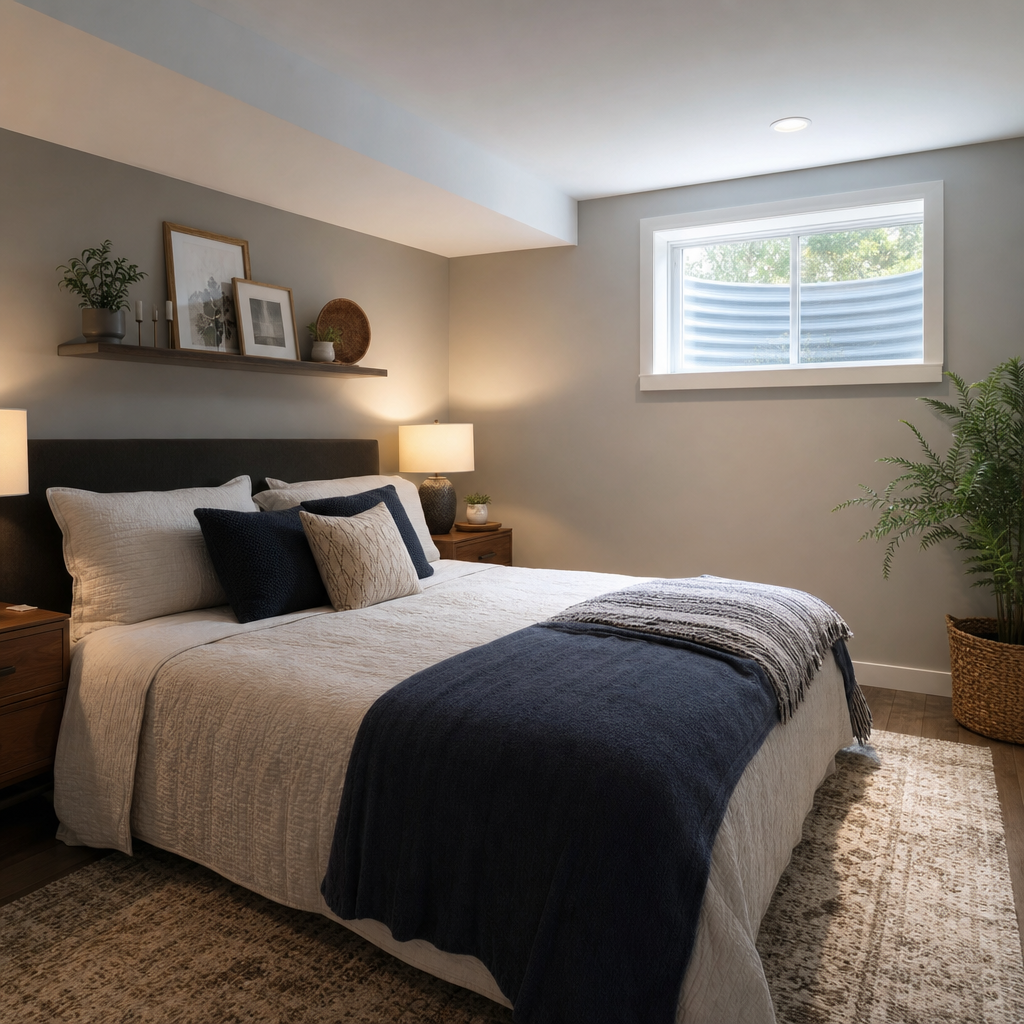
Basement window replacement swaps a failing original unit (rusted steel hopper, rotted wood sash, single-pane glass, or glass block) for an insulated modern window in the existing opening, with no concrete cutting. In South Bend this runs $400 to $1,100 per window installed, it takes a few hours, and it runs year-round because nothing gets dug. It is the right fix for a drafty laundry room, a mechanical room, or a rec room. It is not, by itself, the fix for a bedroom; that takes an egress window installation.
What is in South Bend basements now
The city’s housing has a median construction year of 1955, and about a quarter of it predates 1940. The basement windows that came with those houses fall into a few types:
- Steel hopper or awning units, typically 32 by 16 inches or so, hinged at the bottom, single-pane, often painted shut. Rusted frames and no insulation value. The default in Sunnymede, River Park, the Near Northwest, and Mishawaka’s mill-era streets.
- Wood sash basement windows in the older Foursquares and Queen Annes, frequently rotted at the sill from decades of splashback off a well with no drainage.
- Glass block, mortared into the old opening sometime after 1970 to stop the leaks. Solid, secure, zero ventilation, zero escape.
- Aluminum sliders from the 1960s through the 1980s in Twyckenham Hills and the east side, cold to the touch and condensing all winter.
South Bend averages 64.5 inches of snow and a January winter design temperature near 1 degree Fahrenheit on Indiana’s code table. A single pane of glass at grade is where a lot of heating money leaves the house.
What gets installed
Vinyl or fiberglass units built for below-grade openings: dual-pane Low-E glass, welded frames, and an operating style chosen for the room. Sliders and hoppers for ventilation, fixed units where you only want light, in-swing casements where you want the biggest possible opening in the hole you have. Every unit is foamed, sealed, flashed to the exterior, and trimmed inside.
If the old opening had a well with no drainage, this is a good moment to fix that too. See well covers and drainage.
How the swap goes
Measure first: we confirm the opening size, the depth of the old frame, and whether the sill is sound or needs repair. On install day the old unit comes out, steel frames are cut free and rusted anchors ground flush, glass block is chipped out to the masonry. The opening is cleaned, a treated buck or the existing frame is prepped, and the new window is set, shimmed plumb, foamed at the perimeter, flashed on the exterior side, and sealed. Interior trim finishes it. One window is a couple of hours; a basement’s worth is a day. Nothing outside gets dug, so there is no mess in the yard and no dependence on the weather.
The replacement window exemption, and its limit
This is the part worth understanding before you call anyone. The 2020 Indiana Residential Code adopts the 2018 IRC, and Section R310.2.5 says replacement windows are exempt from the egress sill height rule (R310.2.2) and the net clear opening rule (R310.2.1) provided three things are true:
- The replacement is the manufacturer’s largest standard size that fits the existing frame or rough opening.
- It is the same operating style as the old window, or a style that provides an equal or greater opening.
- The replacement is not part of a change of occupancy.
So swapping the hopper in a laundry room is straightforward. Swapping the hopper in a room you are about to start renting as a bedroom is a change of use, and the exemption does not apply: that room needs a full 5.7-square-foot opening under R310.2.1, a sill within 44 inches of the floor, and a compliant well. Any contractor who tells you a “big” replacement window in the old hole makes the room a legal bedroom is either misreading the code or hoping you will not check. The code compliance upgrades page covers the honest version.
Glass block: keep it or replace it?
Glass block was the South Bend fix for leaky basement windows for a generation, and in a mechanical room it can stay forever. The reasons people replace it:
- No ventilation. A basement with a dehumidifier running from May to October wants an operable window.
- No light control and no view. Block glows; it does not let you see out.
- It is the only thing in the opening. If the room behind it is being finished, a sealed block panel is a dead wall.
- It is in a bedroom. Then it has to go, and the opening has to grow.
The block gets cut out, the opening cleaned and prepped, and a modern operable unit set in the same hole. Same $400 to $1,100 range; block removal is the slower version.
What a swap costs, and what moves it
| Situation | Typical installed price |
|---|---|
| Standard steel hopper to vinyl slider or hopper | $400 to $650 |
| Glass block removal and operable replacement | $600 to $900 |
| Rotted wood sash with sill repair | $600 to $1,000 |
| Oversized or fiberglass unit, or in-swing casement | $800 to $1,100 |
Three or four windows on one visit bring each one toward the low end. Exterior well repair, if the old well is rusted through, is separate; see window well installation. The pricing page has everything in one place.
Permits
A like-for-like window replacement in an existing opening does not involve structural work, and in most of the area covered it does not require a building permit. Enlarging the opening always does. Mishawaka and Goshen both list windows among the projects their building departments regulate, so for those addresses we confirm with the office before scheduling. If a permit is needed, ask who files it.
Where and when
South Bend, Mishawaka, Granger, Osceola, Elkhart, and Goshen, twelve months a year. This is the one service on the site that does not care about frost depth. If you are staring at frost on the inside of a basement window right now, that is the call.
Frequently Asked Questions
How much does basement window replacement cost in South Bend?
$400 to $1,100 per window installed in the existing opening: removal, new insulated unit, foam and sealant, flashing, and interior trim. Multiple windows on the same visit come in at the lower end each. No concrete cutting is involved, so no structural permit.
Can a replacement window make my basement room a legal bedroom?
Only if the existing opening is already big enough. Most South Bend basement openings are 32 by 16 inches or smaller, far short of the 5.7 square feet R310.2.1 requires. A swap improves light and efficiency; a bedroom needs the opening enlarged, which is the egress window installation job.
Does a replacement window have to meet egress code?
Not for a non-sleeping room, and the 2020 Indiana Residential Code has a specific exemption (R310.2.5) for replacement windows that are the largest standard size fitting the existing opening, the same or a larger-opening operating style, and not part of a change of occupancy. Turning a laundry room into a bedroom is a change of use, and the exemption does not cover it.
Can you do this in winter?
Yes. A swap in an existing opening involves no digging, so it runs all year. Winter is actually when most South Bend homeowners notice the draft and the frost on the inside of the old glass.